Midway through 2026, an economic pattern is emerging: conditions on the ground are turning before sentiment or pricing can catch up, leaving a gap between how the economy is operating and how people feel the economy is operating. For real estate, we believe this creates an opening to buy in environments where fundamentals might be better than pricing suggests.
We believe the case for real estate is strong, though not without a need for selectivity. The opportunity we see heading into the second half of 2026 comes in underwriting the recoveries that are already visible in the data while staying clear of areas where pricing may have already moved too far ahead of fundamentals.
In our latest House View, we examine the data driving our investment strategies, but here we outline five things we think are critical for investors to know in this environment.
1. The economy looks strong on paper, but the experience is mixed.
There is a meaningful gap between how the economy is actually performing and how people perceive it to be performing. Looking at the numbers, the picture is rosy: GDP rose 2% in the first quarter, consumer spending has held steady, and businesses are still investing heavily in AI.1
Yet ask most people how the economy is doing, and the answer would likely be far less optimistic. In May, the University of Michigan’s consumer sentiment index fell to its lowest level on record, even as growth and employment held steady.2 It has since recovered somewhat but remains well below where it stood to start the year. This type of disconnect creates opportunity, as property prices tend to reflect sentiment as much as fundamentals. When the two diverge this sharply, disciplined investors have room to act before confidence catches up to the data.
The Divide: why is sentiment so disconnected from reality?
- The Complexities of Today’s Labor Market
Despite labor data looking good, new graduates and those already unemployed are having trouble finding jobs.
- Fears of AI
While AI has yet to take a meaningful share of jobs, the doomsday headlines have left many feeling uncertain about the future of their roles and industries.
- Inflation Fatigue
The rate of inflation has slowed, but the price changes over the last five years are impossible to miss. Everything feels expensive, even if consumers can still afford to buy.
2. Markets have flipped from pricing in rate cuts to bracing for a hike by year-end.
Early this year, most market participants expected the Federal Reserve to continue cutting rates, but that expectation has since reversed. Inflation has proven persistent in the areas that matter most – shelter, healthcare, and insurance – while labor market risks have subsided. This has pivoted the Fed’s policy agenda from easing toward tightening.
The scale of that shift has been significant. At its June meeting, the Fed’s median rate projection moved from anticipating a cut in March to signaling a possible hike. Futures markets moved just as fast, with the implied probability of at least one hike by December rising from roughly one in four to better than three in four within a month. For real estate investors, the practical implication is the same either way: planning around further rate cuts should no longer be the default assumption, and underwriting should reflect that.
Evolution of Market Probability of Rate Outcome at December 9, 2026 FOMC Meeting
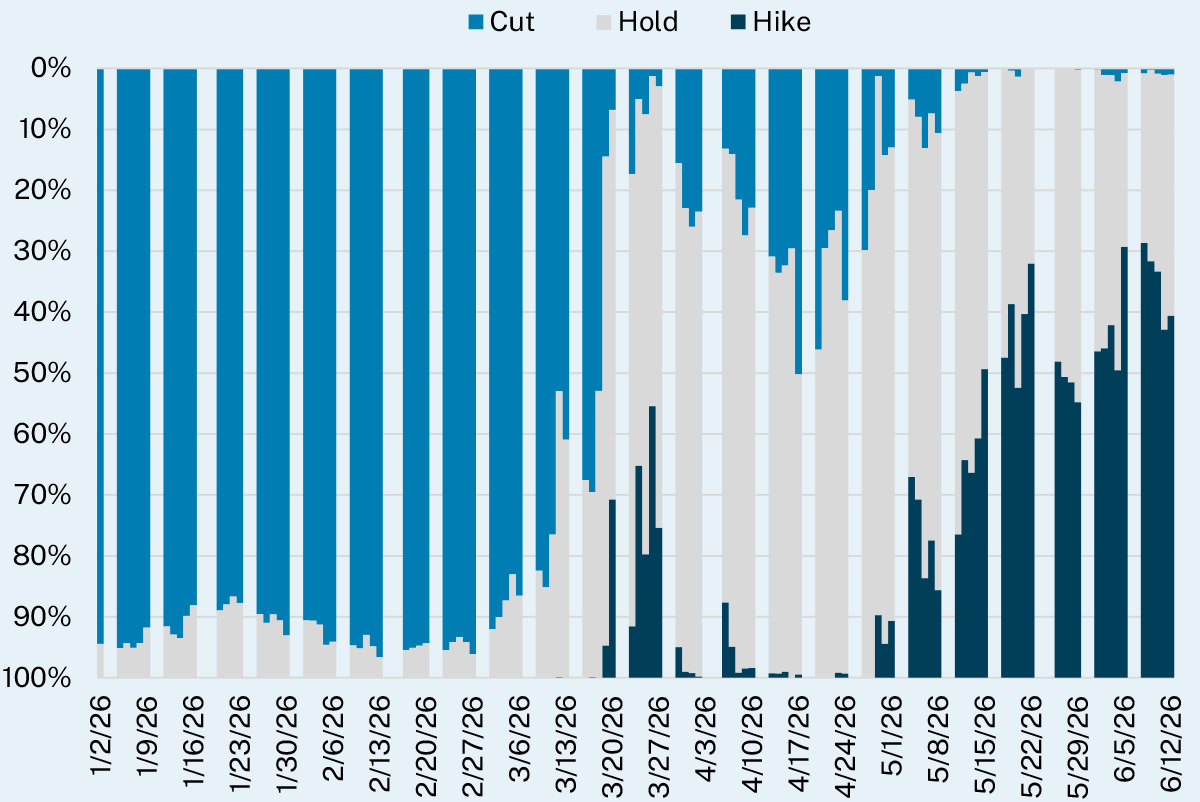
Source: American Realty Advisors based on data from CME FedWatch as of June 12, 2026. Cuts reflect the cumulative probability of target range being below 350 bps. Hold = probability of 350 – 375 bps (current target range). Hike reflects the cumulative probability of target range at or above 375-400 bps.
3. Without falling rates as a tailwind, returns will need to come from rent and operations alone.
Given where rate expectations stand now, we believe it would be a mistake to underwrite deals assuming any rate drops. Even in a more favorable scenario where the Fed holds steady, nothing points to the kind of sustained rate-cutting cycle that historically did much of the heavy lifting for real estate returns in the post-GFC cycle. That shifts the burden of achieving returns onto the property itself: rent growth and hands-on management become the primary drivers of returns.
In practice, that means filling vacancy, managing lease renewals well, and controlling costs are what will separate strong returns from weak ones over the next few years. Investors who treat this as an environment where returns are earned property by property, rather than delivered by the macro backdrop, are better positioned regardless of which way rates ultimately move.
4. Multifamily and industrial are turning a corner ahead of consensus.
New apartment construction has declined for 11 consecutive quarters, falling from 18% of existing inventory to just under 6%, and rent growth just posted its strongest quarterly gain in more than two years.3 With fewer new units competing for tenants, existing landlords are regaining some of the pricing power they lost during the recent supply wave. Industrial markets are showing a similar dynamic, as markets where demand is improving now outnumber those weakening by roughly two to one, putting the sector on better relative footing than just a year ago.4
The opportunity in this inflection is that pricing has not caught up. Cap rates are still largely set based on the supply glut of the past few years, which means investors who move ahead of the broader market can buy into the recovery early. The pace of the turn varies meaningfully by market, with some metros, particularly those that experienced the heaviest supply over the past cycle, still working through it. The strongest entry points are those markets where limited construction has preserved pricing power and occupancy throughout the downturn.
5. Real estate continues to outperform bonds, even with today’s tight spreads.
Real estate has a long record of outperforming bonds over time, and that record has held up even as cap rate spreads over Treasuries have narrowed. Looking at any 10-year period over the past four decades, private real estate has generally outperformed bonds in total returns, largely because rent growth and active property management contribute returns that a bond cannot generate. The one period bonds meaningfully won this comparison required interest rates to fall from record highs in the 1980s, a scenario that is difficult to repeat given today’s deficits, low absolute starting interest rate levels, and persistent inflation.
10-Year Annualized Total Returns, Core Private Real Estate and U.S. 10-Year Treasuries
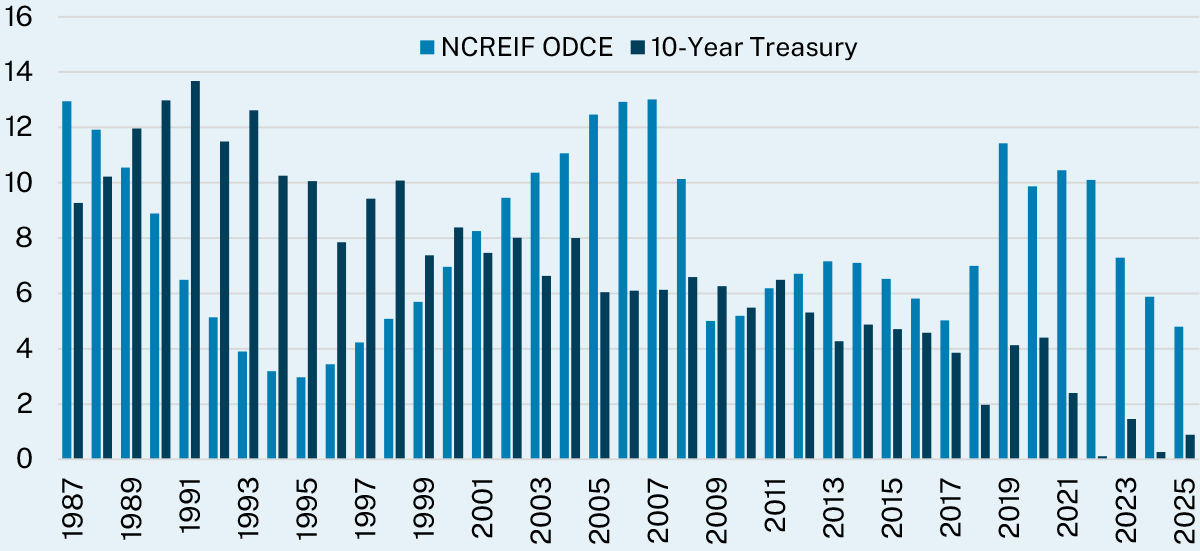
Source: American Realty Advisors based on data from NCREIF and Macrobond as of June 2026. NCREIF ODCE returns reflect total returns gross of fees to be comparable with gross returns on a 10-Year Treasury bond held to maturity.
A narrower spread raises the bar for how real estate outperformance gets earned, favoring strategies and investors that prioritize selectivity and active oversight of property operations. For investors who can execute, the return advantage now goes more clearly to the operators who earn it, rather than being available more broadly by default.
Notes
1 Sources: Federal Reserve Bank of St. Louis, Bureau of Economic Analysis, and the U.S. Census Bureau as of July 2026.
2 Source: University of Michigan Consumer Sentiment Survey results as of June 2026.
3 Source: CoStar as of July 2026.
4 Source: CoStar as of July 2026.
Disclosures
The information in this newsletter is as of July 9, 2026, and is for your informational and educational purposes only, is not intended to be relied on to make any investment decisions, and is neither an offer to sell nor a solicitation of an offer to buy any securities or financial instruments in any jurisdiction. This newsletter contains a mix of (i) statements of fact and (ii) opinions, beliefs, estimates, expectations, and other forward-looking statements. Statements of fact are based on information we believe to be reliable, but we do not represent that all such information is complete or accurate in all respects. Opinions, beliefs, estimates, and forward-looking statements are inherently uncertain, are based on judgment and assumptions as of the date indicated and may change without notice. They are not guarantees of future results. Except as required by law, American Realty Advisors assumes no obligation to update any such forward-looking statements. This newsletter is proprietary to ARA and may not be copied, reproduced, republished, or posted in whole or in part, in any form and may not be circulated or redelivered to any person without the prior written consent of ARA.





Mid-Quarter Economic Pulse: Q3 2026