Private core real estate funds have posted eight consecutive quarters of positive total returns, with two back-to-back quarters of modestly positive appreciation.1 Using history as a guide, we look at two prior real estate resets – the 1990s and the Global Financial Crisis (GFC) – to see what they might suggest about the path forward for values today.
The resets in real estate values from the early 1990s as well as the value decline that occurred alongside the GFC in 2007-2009 share a similar magnitude, though their pace and shape differed materially. The unlevered NCREIF Property Index (NPI), which reflects property-level performance without the influence of debt or fund structuring, saw values decline a cumulative 32.3% from peak to trough between 1989 and 1995 (a 6-year slide), with a similarly sized 31.6% peak-to-trough decline occurring in a two-year period between 2008 and 2010 (Figure 1).2
Figure 1 – Private Real Estate Value Declines and Recoveries (Index as a % of Prior Peak by Quarters After Peak)
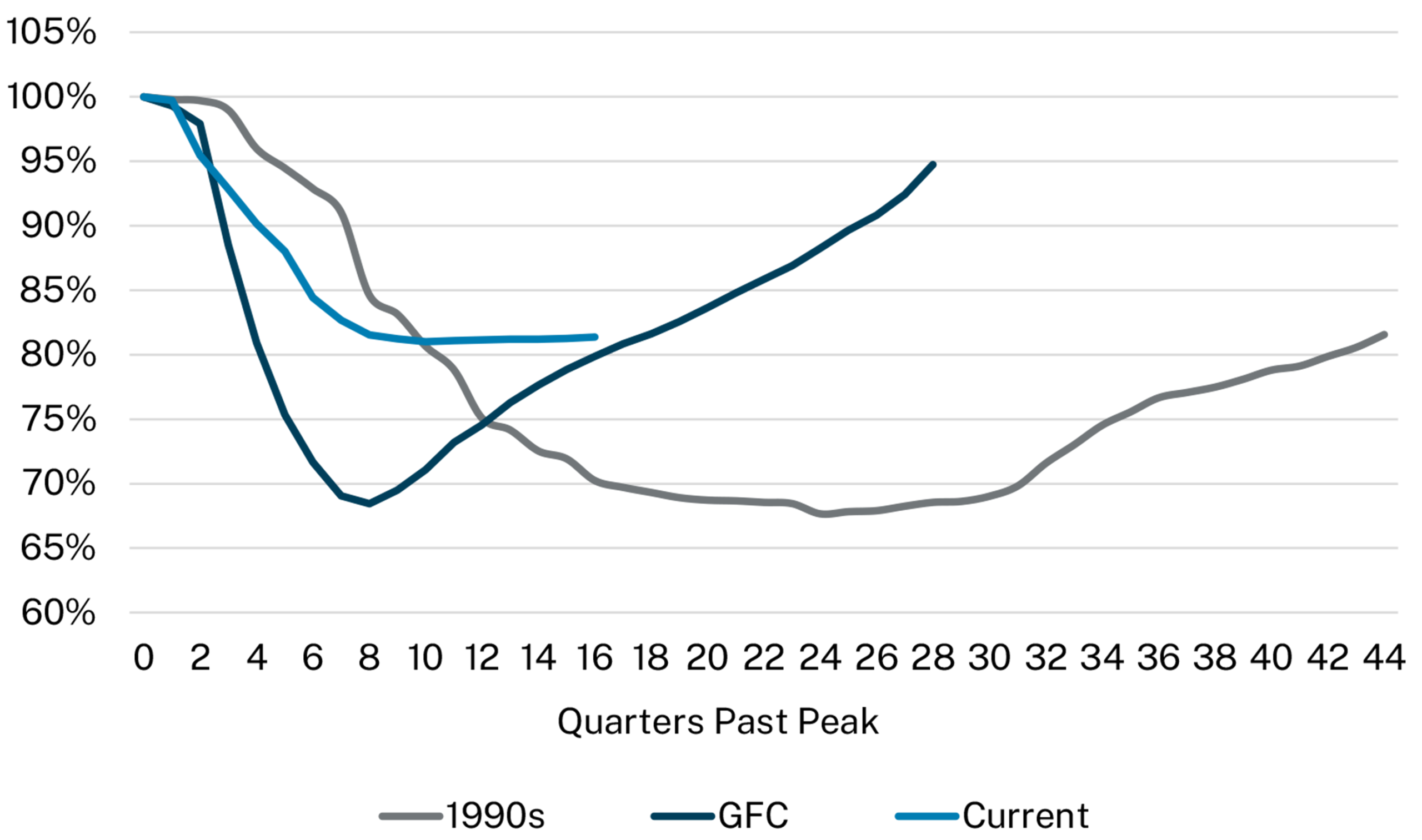
Source: American Realty Advisors based on data from NCREIF as of September 2026. 1990s line reflects the peak of the NPI appreciation index in Q4 1989 and trough in Q4 1995. GFC line reflects peak in Q1 2008 and trough in Q1 2010. Current period reflects peak in Q2 2022 and trough in Q4 2024, with latest/16th quarter data point as of Q2 2026.
The recent value decline was much shallower at -19% over 10 quarters.
The pace of recovery has, so far, tracked closer to the 1990s path than the rapid, rate-cut-fueled rebound that followed the GFC. Six quarters after the bottom, the current cycle has recovered just 1.8% of its peak-to-trough decline, compared with 29.2% over the same period following the GFC. Without the benefit of aggressive rate cuts and resulting cap rate compression, we would expect today’s recovery to be driven more by fundamentals, which points to a longer, but potentially more durable, basis for value recovery. That said, the current downturn was considerably shallower than the 1990s decline, leaving values with less ground to make up and suggesting that a similarly gradual recovery need not take as long to return to prior peak levels.
We think this backdrop suggests that the opportunity to benefit from a real estate recovery remains viable for the foreseeable future. In other words, we do not think the window of opportunity has closed.
The pattern observed in the overall NPI – one of a shallower decline and correspondingly slower recovery than in periods past – has generally held up at the property sector level with the exception of office. The variation we are seeing reflects different fundamental positioning and possible signals for where value may be mispriced today.
Industrial, retail, and residential values all bottomed in 2024 at troughs shallower than one or both historical periods, and each has thus far recovered more slowly.3
Industrial stands out for its modest decline. At a -12.9% peak-to-trough drop, its value loss is less than half the depth of either historical reset, suggesting fundamentals remained relatively resilient even as financing costs reset values market-wide.
Residential tracked almost exactly with its 1990s decline (-16.9% vs. -16.7%), and retail sits closer to the typical magnitude experienced in both historical resets, despite being in a fundamentally different supply-demand balance today than in the mid-2000s (Figure 2).
Taken together, these sectors have now bottomed and still have considerably more room to recover than the pace of the last few quarters has captured. Historically, resets have been followed by multi-year periods of substantial value recovery, and we believe today’s entry basis represents a compelling opportunity for investors looking for a multi-year runway for values to continue to recover.
Figure 2 – Peak-to-Trough Value Decline by Sector and Cycle
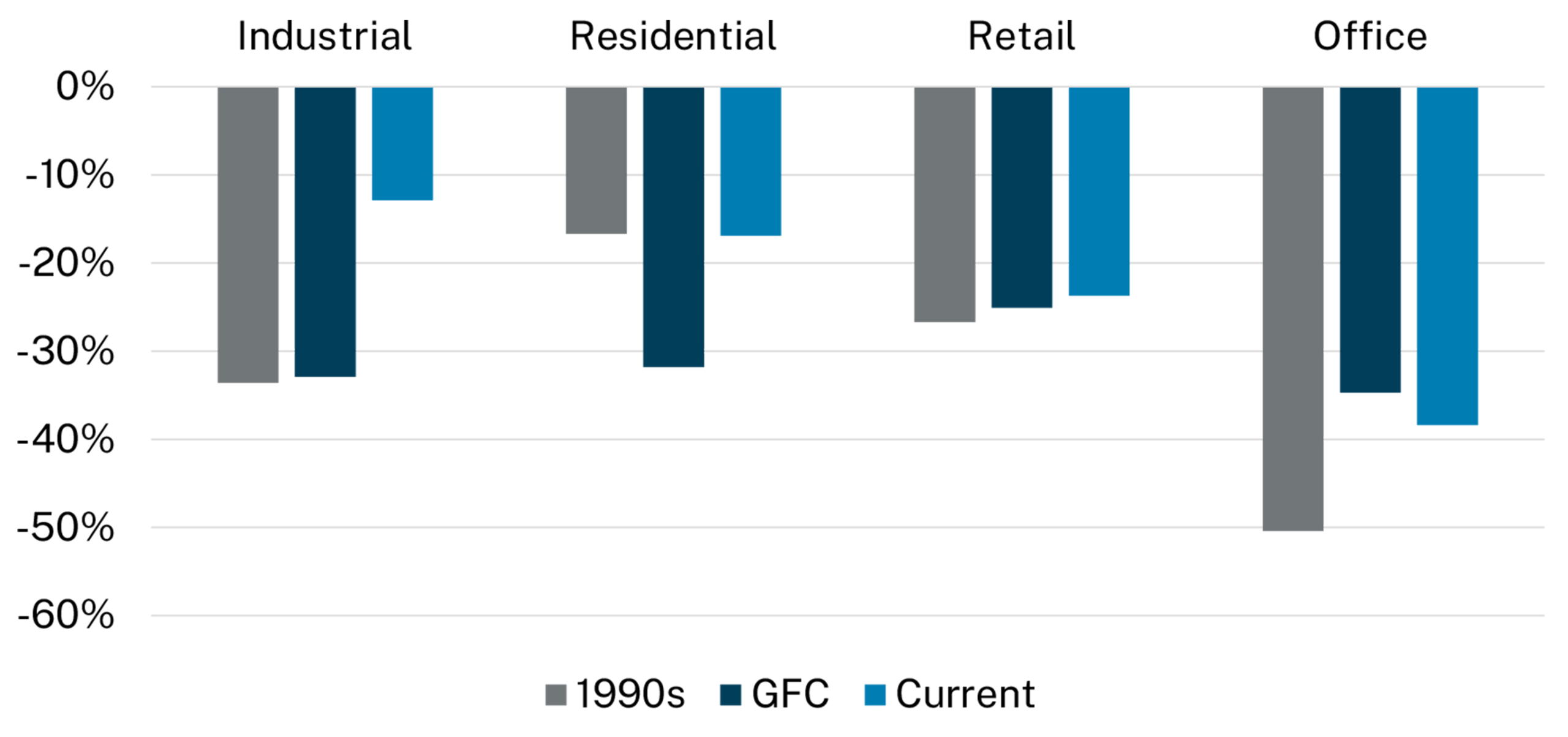
Note: Current-cycle declines reflect Industrial (Q3 2022–Q2 2024), Residential (Q3 2022–Q3 2024), and Retail (Q2 2018–Q2 2024) peak-to-trough declines. Office (Q1 2020–Q2 2026) reflects peak-to-date, as values have not yet reached a trough. 1990s line reflects the peak of the NPI appreciation index in Q4 1989 and trough in Q4 1995. GFC line reflects peak in Q1 2008 and trough in Q1 2010. Current period reflects peak in Q2 2022 and trough in Q4 2024, with latest/16th quarter data point as of Q2 2026.
Source: American Realty Advisors based on data from NCREIF as of September 2026.
Office is a separate case entirely – values have declined 38.4% from their 2020 peak (already deeper than the sector’s GFC decline) and have yet to turn positive, suggesting we are still waiting for the bottom. That makes office less of a broad recovery story today and more of a highly selective opportunity, where asset quality, market conditions, and the durability of tenant demand will determine which properties recover and which continue to struggle. While the depth of the decline may create compelling opportunities for investors, capturing that upside will require patience and a disciplined focus on quality and location.
We see three key messages:
- The magnitude of the opportunity is real and remains only partially realized. Values across core sectors remain meaningfully below prior peak, and history suggests that the gap closes substantially over a multi-year horizon.
- Expectations of the pace, not the thesis, should be recalibrated. Investors anchoring their expectations for this cycle to the sharp, rate-cut driven GFC recovery should expect this cycle to unfold more gradually, which argues for diligence in underwriting and operations, not a hesitancy to participate.
- Selectivity matters more than timing the market. Sector-level divergence suggests the more actionable question isn’t “is it time to buy real estate?” but rather “which sectors are recovering from a position of genuine fundamental resilience?” – a question that comes down to asset and market selection.
Notes
1 Source: NCREIF Fund Index – Open End Diversified Core Equity (ODCE). Statement based on value-weighted gross total and gross appreciation returns of the index.
2 Source: NCREIF Property Index. Based on appreciation indices.
3 NCREIF Property Index (NPI), unlevered appreciation index, by property type as of Q2 2026.
Disclaimer
The information in this newsletter is as of October 7, 2026, and is for your informational and educational purposes only, is not intended to be relied on to make any investment decisions, and is neither an offer to sell nor a solicitation of an offer to buy any securities or financial instruments in any jurisdiction. This newsletter contains a mix of (i) statements of fact and (ii) opinions, beliefs, estimates, expectations, and other forward-looking statements. Statements of fact are based on information we believe to be reliable, but we do not represent that all such information is complete or accurate in all respects. Opinions, beliefs, estimates, and forward-looking statements are inherently uncertain, are based on judgment and assumptions as of the date indicated and may change without notice. They are not guarantees of future results. Except as required by law, American Realty Advisors assumes no obligation to update any such forward-looking statements. This newsletter is proprietary to ARA and may not be copied, reproduced, republished, or posted in whole or in part, in any form and may not be circulated or redelivered to any person without the prior written consent of ARA.




Mid-Quarter Economic Pulse: Q3 2026